All posts by: Jenny O'Grady


Student Turmoil at UMBC 40 Years Ago — What Happened?

This essay was written by Manus O’Donnell ’72, English, who served as editor of the Retriever Weekly and as a senator in the Student Government Association.

A little over 40 years ago UMBC was embroiled in protests and occupation rumors. The Viet Nam War created a lot of controversy in that period. 8 students were killed by National Guard during the riots at Kent State University in Ohio. Colleges everywhere had spontaneous student rioting. Across the country student bodies were organizing and college administrations were scrambling. UMBC was no exception. An envoy from Rutgers University came to recruit UMBC into the national movement to shut down America’s college campuses in protest of the Viet Nam War.

The UMBC People’s Party had recently formed and was interested in promoting protests against the War and supporting Women’s liberation and in general changing how UMBC operated. The Student Government Association (SGA) officers and the People’s Party were in constant communication during the “riot preparations”. The Administration also wanted to have the SGA play a role in these turbulent times. So, here was the SGA in the middle of an Administration who wanted peace & calm and the People’s Party who wanted to disrupt the campus in order to make their political positions known to all. There were some sit-ins, but they were generally well controlled and peaceful. The UMBC SGA chose not to follow the national trend. Rather, we chose to forge our own path for involvement, yet in a peaceful way. Rioting would be a bad move for our relatively new campus.

Rumors circulated that the National Guard was preparing to use riot gas on the campus. That’s when I first got involved with the SGA. Being new to campus, I looked for a group to join. First, I went to a People’s Party meeting. They seemed too loose and anti-establishment. Then, I went to the SGA meeting where they were discussing what students should do if the campus is gassed. Being fresh out of the military, I was the only one who had experience with riot gas. They were anxious to hear what I knew. From then, I was hooked into the student government as Director of Student Activities, Junior Class president, and co-editor & writer for The Retriever.

Bill Soltesz was the Student Government (SGA) President at that time. Bill, along with Sal Maggio, Mike Runge, Mike Brushe and Manus O’Donnell were in meetings daily with Chancellor Albin O. Kuhn and Homer Schamp. Our common goal was to keep UMBC peaceful, yet active in the student movement. We also had emergency meetings with the Faculty Senate to discuss our options as a University Community.

The SGA, led by Bill Soltesz, was instrumental in being the mediator between the administration and the protestors. There were many rumors of unrest coming to UMBC. One rumor stemmed from the “Catonsville 9” who, led by the Berrigan Brothers who were Jesuit priests opposed to inhumanity of war. The “9” spilled blood over Selective Service (draft) records in the Catonsville draft office. Back then, men were recruited into the service by lottery, meaning, if you did not have an exemption, you would be drafted into the Military Service. No questions asked, you go! There were some “draft dodgers” who went to Canada to avoid the draft.

So what happened, you’re asking by now. The SGA asked Dr. Kuhn to convene an emergency meeting of the Faculty Senate to deal with the question of how to end the school year. Many students, inspired by the People’s Party, clamored for the school to shut down. No more school that year. The SGA officers took the position that it would not benefit all students to do that. Some students wanted to take finals so they could pull their grade up (have you been there?). Other students didn’t want finals to pull their grades down.

The Faculty Senate, at the urging of the SGA, came up with a compromise. This compromise settled the campus down. No more riots were imminent. The National Guard had no need to occupy the campus. Many campuses across the country were shut down. UMBC, once again, was a leader in “how to run a campus successfully with all parties involved”.

The resolution was to make final exams optional. If you wanted exams, take them; if not, then you get the grade as it stands before the exams. How many students would like to have optional exams today?

UMBC remained open. UMBC was relatively peaceful, involved in current affairs and productive for the student body. More importantly, UMBC acted as a whole community with Students, Faculty and Administration working together for the common good of OUR UMBC.

Up on the Roof – Fall 2012

President Hrabowski

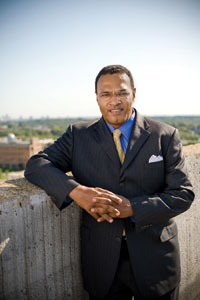
UMBC President Freeman A. Hrabowski, III, takes your questions.

Q. When you speak about UMBC’s achievements, you always stress the contribution made by your predecessor as president: the late Michael Hooker. What is his legacy at UMBC? What role did he play in your life as a mentor and friend? — Richard Byrne ’86, English

A. Michael Hooker was capable of seeing what others did not think possible. He clearly saw the great potential of UMBC to become an increasingly important institution of higher education in our country.

He had no trouble saying that UMBC was going to be the best university of its size and its kind in the country. And it sounded like hyperbole. Except he really believed it.

Michael also saw that the entire Baltimore region could go to the next level by focusing on higher education. He got a number of people to visit the university. He also began to see taking people to the roof of [the Administration Building] as a way to allow them to see the campus – and the campus connection with downtown Baltimore. I take people to the roof because Michael taught me to take people to the roof.

Wherever Michael Hooker went, whether it was to Massachusetts, or to North Carolina, or when he was here at UMBC, people called him a whirlwind. He had a way of moving with great energy and excitement. People were either fascinated with him, or they were bothered by what he said. And Michael preferred people being bothered by what he said to being boring.

I was always taken by his intellectual curiosity. He was always excited by what was new at UMBC, and he was seeking it out and asking questions – be it in the labs or in the theatre productions.

When I first visited here, and I was not necessarily thinking of moving to this university, Michael said to me: “You’d be good for UMBC. And UMBC would be good for you. It’s time for you to move to another position.” And at first it somewhat upset me. I thought: “This man doesn’t know me. How dare he say what’s best for me?” But he had a way of saying it with confidence. And as intellectual as he was, he used his gut in making decisions. He saw that he could trust me.

He told me on the first day I came to work here as vice provost: “You’re going to be president of this place one day.” And I said: “Yeah, right, Michael.” I was always saying that to him: “Yeah, right, Michael.”

We were constantly memorizing things and reciting them together. Poetry, or things we had read. He was always pushing me. Another quality Michael possessed, however, was that he listened. My argument to him was that we needed to make sure that all of UMBC’s students – graduate and undergraduate – were having a good experience. He listened, and then he said: “Well, do it. Make it happen.” He liked bringing people with good ideas around and having them take those ideas to reality.

Michael had tremendous pride in UMBC as an institution, even after he left. When you look at the True Grit statue outside the Retriever Activities Center, that was Michael, too. If you asked him what he did at UMBC that really mattered, he’d say that he wanted that dog out front. As a symbol. At the time, it seemed like a kooky idea. But whenever Michael came back to campus, he would point to it.

To the very end, when Michael was dying and I went to see him at National Institutes of Health, his eyes reflected his spirit. He was still elevating and supporting me. He wanted to hear about UMBC. He always sang UMBC’s praises.

Freeman with Michael Hooker

To send a question to President Hrabowski, click here.

To You – Fall 2012

Headshot of Richard ByrneTraditions don’t start easily. Someone has to plant the seeds. Attract attention to them. Nurture them. Allow them both to grow and take root.

The image on the cover of the Fall 2012 issue of UMBC Magazine is one tradition that has taken root at the university. UMBC’s presidential insignia – worn by the university’s president at every commencement – was a gift from the university’s Alumni Association that recognized the school’s milestone 30th anniversary in 1996.

The insignia was purposely created to have a contemporary look that reflected the innovation that characterized the institution. The insignia’s design includes not only the university seal, but also incorporates three symbols that represent the key pillars upon which UMBC stands as a proud public university in Maryland: teaching, research and service. There are also visual references to the iconic Albin O. Kuhn Library in its design – rooting the insignia firmly in campus space.

At the time of its completion in 1998, UMBC’s director of alumni relations Joan Williams observed that she hoped the insignia was “just the beginning of many more traditions to come.” But little did she know that the president who first wore the insignia 14 years ago would still be the university’s leader in 2012.

Our cover story in this issue examines the 20 years of transformation at UMBC that have occurred under the leadership of Freeman A. Hrabowski, III. (See “From Aspiration to Achievement”).

Stability also helps nurture traditions. UMBC’s two decades with Hrabowski at the helm have given the university the ability to innovate in an environment of continuity – and thus advance the commitment to teaching, research and service that are part of the design of the university and its insignia.

As a young university with a growing sense of its legacy and its promise, the students, faculty, and staff of UMBC make history every day. And alumni can do it, too. Everything that happens at UMBC now lays the foundation for the university’s future.

For instance, every year that there is a bonfire at UMBC Homecoming brings that conflagration another step away from being an “annual event” and one step closer to being a “tradition.” And every year that The Retriever Weekly publishes during the first week of school – as it has since 1966 – makes the university’s student newspaper more of an institution.

Both the bonfire and The Retriever Weekly will figure prominently in this year’s UMBC Homecoming 2012. The bonfire will be set at dusk on Wednesday, October 10. And a reunion of staff members of The Retriever Weekly will happen on Saturday, October 13, at 2:30 p.m.

We hope to see you at Homecoming 2012. You will see how UMBC nurtures the traditions it has as it creates new ones – and you can help us make history in continuing them.

— Richard Byrne ’86

The News – Fall 2012

FIRST IMPRESSIONS

By the time you read this, the first phase of UMBC’s Performing Arts and Humanities Building will already be teeming with students and faculty eager to study, teach, work and play in the brand-new space.

So what are they seeing as they walk into the building? UMBC Magazine managed to get a peek as the furniture arrived – and just before faculty and staff moved into the place in late July.

One of the jewels of the new building is the 275- seat proscenium theater (1), which is a significant upgrade on the theatre department’s former performing space, which opened in 1968. The upgrade isn’t just in the sightlines and the two tiers of seating, but also in much wider and taller expanses available for set design and construction backstage.

Another feature of note in the new building is the strong use of natural light in the design. The emphasis on natural light in conference rooms and classrooms (2) also comes with impressive views of other parts of campus, including the nearby Fine Arts Building. And the open vistas of public space such as the building’s main entrance (3) allow the natural light to play on architectural features such as the pronounced curved design encompassing the Dresher Center for the Humanities.

The first phase of the Performing Arts and Humanities Building also includes a state-of-theart black box theatre (above) for smaller scale productions. The design of the black box allows for a variety of lighting possibilities within the space (4), and room for audiences of up to 120 guests.

In addition to housing the theatre department and the Dresher Center for the Humanities, the first phase of the building is also home to the English Department (5), the Linehan Artist Scholars Program, and the Humanities Scholars Program. Both on the outside (6) and the inside, students, faculty, staff, and visitors will see a building that not only is aesthetically pleasing, but advances teaching, research, and creative endeavors at UMBC.

But what those who work, study, or attend performances in the new building’s first phase won’t necessarily see may be just as important. The Performing Arts and Humanities Building is projected to incorporate enough sustainable design strategies to be designated as a LEED Silver project.

Literally from top to bottom, the building has features that are designed to advance the university’s sustainability efforts. The building’s white roof aims to reduce the structure’s “heat island” effect. The impervious area around the building has been shrunken to reduce rainwater runoff, and pervious concrete has been employed to aid with that effort. There is even a system that harvests rainwater for irrigation.

While the fences and cranes have moved from the front of the building, the work site at the north edge of campus won’t be closing down anytime soon. Construction has already begun on phase two of the building, which will open in 2014 and provide a new home for the departments of dance, music, philosophy and ancient studies, as well as a 350-seat concert hall and a 120-seat dance studio. For more information about the opening festivities on Wednesday, September 19, including a ceremonial ribbon cutting with Maryland Governor Martin O’Malley, a presentation on cultural spaces hosted in collaboration with the Greater Baltimore Cultural Alliance, an outdoor celebration of the arts and humanities, and a Humanities Forum lecture featuring American Council of Learned Societies President Pauline Yu, see our online calendar.

— Richard Byrne ’86

OVAL OFFER

Hrabowski and Obama

Call it “Mr. Hrabowski Goes to Washington.”

UMBC’s president Freeman A. Hrabowski, III, stood with other leaders behind Barack Obama on July 26 in the Oval Office of the White House, watching as the nation’s 44th president signed an executive order creating the President’s Advisory Commission on Educational Excellence for African Americans.

Hrabowski was named chair of the new commission, which will coordinate the response of federal agencies to this critical issue and identify best practices nationwide. The commission also will lead a national dialogue on African American achievement from early childhood through adulthood.

UMBC’s president believes that the lessons learned during his 20-year tenure will inform his leadership of the commission.

“The work of my colleagues at UMBC has demonstrated that education in America can be both inclusive and excellent,” Hrabowski observed. “Our African American students study with people from all over the world and achieve at the highest levels. I am delighted that the President is again committing to the success of all students.”

Hrabowski will also draw on his other work on national education issues, including chairing a National Academy of Sciences committee that examined minority participation in the sciences. That committee’s final report concluded that the United States must significantly increase its investment in young people of all races interested in science, technology, engineering and math to remain competitive in the global economy.

— Elyse Ashburn and Richard Byrne’ 86

WELCOME BACK

Homecoming 2012

Maybe it’s been a few years since you took your last exam at UMBC. So what better time to pay a return visit to campus than October 10th to 13th for Retriever Fever: Homecoming 2012?

UMBC’s Homecoming Committee has arranged for a wide array of events and activities to lure you back. Among the highlights?

  • Homecoming Bonfire & Outdoor Movie  Warm up at one of UMBC’s cherished traditions and catch a free outdoor showing of The Amazing Spider-Man. (Wednesday, October 10, at dusk, Erickson Field)
  • Outstanding Alumni of the Year Awards   UMBC’s Alumni Association honors distinguished alumni for their accomplishments and dedication to the university. (Thursday, October 11, 7:30 p.m., Albin O. Kuhn Library Gallery)
  • Big Prize Poetry SLAM!   Get your first glimpse of the new Performing Arts and Humanities Building at a reading hosted by UMBC’s English Department. (Friday, October 11. 6-8 p.m., Performing Arts and Humanities Building Atrium)
  • Reinventing Radio: A Morning with Ira Glass   Listen to the creator of This American Life, heard on more than 500 public radio stations each week. (Saturday, October 13, 10 a.m., University Center Ballroom)
  • UMBC vs. Boston University  The UMBC men’s soccer team takes on Boston University in a must-see America East conference matinee (Saturday, October 13, 3 p.m., Retriever Soccer Park)
  • Taste of UMBC: Crab Feast  It doesn’t get more Maryland than delicious crabs, great friends and music! (Saturday, October 13, 5-8 p.m., UMBC Quad)

You can find information on more events and how to register at the UMBC Homecoming 2012 website.

— Richard Byrne ’86

LABOR WE LOVE

Great Colleges

UMBC is a fast-growing public university, but one of its successes is that it still retains the personal touch of a much smaller institution.

One reason that UMBC has managed to make a midsized research university so welcoming is the university’s dedicated faculty and staff – many of whom go the extra mile to ensure student success, clear up red tape, obtain resources to create environments for exceptional teaching and research, or keep the campus looking attractive and inviting.

That UMBC’s faculty and staff enjoy that work is also part of its reputation. The university’s annual faculty and staff awards program is an annual highlight on the community’s calendar. And one can find even more confirmation of that positive attitude in the latest edition of The Chronicle of Higher Education’s annual survey of “Great Colleges to Work For.”

UMBC was named to the “Honor Roll” in the Chronicle’s 2012 survey because its own faculty and staff ranked it highly in seven of the 12 areas canvassed by the newspaper. Those who work at UMBC ranked the university highly for its “collaborative governance,” “professional and career development,” “work/ life balance,” “confidence in senior leadership,” “supervisor/department chair relationship,” “respect and appreciation,” and “tenure clarity and process.”

Schools that earn mentions in a category must rank in the top ten of one of three categories, sorted by enrollment. The responses to the survey by UMBC employees selected at random are a key factor in the rankings.

— Richard Byrne ’86

THE RIGHT CHEMISTRY

Bill LaCourse

William LaCourse, one of the pioneers in UMBC’s efforts to reshape its curriculum for the 21st century, has been appointed as dean of the College of Natural and Mathematical Sciences. He served for almost a year as the interim dean of the college.

UMBC provost Philip Rous lauded LaCourse’s “commitment to enhancing student success at both the undergraduate and graduate levels, to the advancement of faculty, and to forging new links with business, national agencies, and universities at both the college and university level.”

LaCourse joined UMBC’s faculty in 1992. He received his Ph.D. in analytical chemistry from Northeastern University in 1987, and worked at Iowa State University/Ames Laboratory before arriving at UMBC.

As the chair of UMBC’s Chemistry and Biochemistry Department, LaCourse was the founder of the Chemistry Discovery Center, an innovative team approach that removes distractions (no food, no cell phones) and compels students to grapple collectively with the knowledge that they imbibe in the lecture hall.

“The idea is to get them in there to share their collective thoughts,” LaCourse told UMBC Magazine in a 2010 story on the center. “Give them roles to perform, take away their pads and pencils, and make them talk.”

The Chemistry Discovery Center has served as a model for wider innovations in curriculum at UMBC, including the College of Natural and Mathematical Sciences’ Active Science Teaching and Learning Environment (CASTLE), which serves a wider range of students in the sciences and math. Both the Chemistry Discovery Center and CASTLE have been adapted at other universities across the country as well.

— Richard Byrne ’86

Over Coffee – Fall 2012

From the moment we rise each day, we are surrounded by messages from the media: news, advertising, images, sounds, video, texts. How do we make sense of it all intellectually? Students in UMBC’s Media & Communication Studies (MCS) major are trying to do just that. UMBC Magazine sat down with Jason Loviglio, director of the program, and Donald Snyder, a lecturer and director of the MCS internship program, to find out more about one of UMBC’s fastest growing majors.

* * * * *

UMBC Magazine: People might be surprised that many of the major’s introductory classes are grounded in theory, rather than producing media.

Jason Loviglio: Any humanities discipline should have as its goal to help young minds think critically, to peel away layers of distracting information, misleading information, and misinformation to get at implicit truths and implicit facts that are harder to see. All of us on the MCS faculty see ourselves as engaged in the difficult task of encouraging students to think critically, to look for implicit meanings, and to read against the grain whenever possible.

Donald Snyder: We’ve also tried to balance the theoretical core with practical applications of media literacy in the world of today or the world of tomorrow. Students have responded overwhelmingly positively to the push toward internships. We talk to them about the importance of getting really good practical experience and figuring out what it means to be a professional. Our lab-based courses and our new course in media literacy will focus on digital and public projects. It’s very exciting with the technologies we have available to us in terms of production and distribution.

UMBC Magazine: Why is UMBC such a good place for a media and communication studies program?

Loviglio: The fact that the program exists has everything to do with the culture of collaboration at UMBC. There was an interest at the highest levels of the university to create something along these lines. It was entrusted to humanities people and we made it after our own interests: we made it rigorous, we made it critical, we made it writing intensive, and we made it interesting to us.

We also had support from our dean, John Jeffries, and from three provosts. And the most important thing is that we had massive support from other humanities departments and programs, who volunteered time and resources to build the capacity to run a major that is now one of the middle- to large-sized majors in the college. In some cases, they lost students to us. That spirit of collaboration and cross-disciplinary cooperation is a credit to an atmosphere at UMBC that has been encouraged from top-down, but that was really built from bottom-up.

Snyder: With the growth that we’ve experienced, there was certainly a demand for this type of intellectual field at UMBC.

UMBC Magazine: The job market in traditional media is shrinking. What value does an MCS degree offer?

Loviglio: The first thing we’re eager to tell students is what we’re not. We’re not a narrow pre-professional major and we’re not preparing students for specific technical positions within the media industries as they exist right now. What we’re trying to do is much more like what a classical liberal arts discipline has always tried to do, which is teach the skills of communication, critical thinking, and love of learning. The major offers skills that we think will serve students as workers and citizens in the 21st century better than anything else we can think of.

Snyder: Thinking about media in a broader way instead of just narrow media tracks is one of the reasons we built this interdisciplinary model. We’ve had students who have combined environmental science and MCS, communicating essential environmental issues to the public. We’ve had theatre students who have talked about bringing new social media platforms to that more traditional art form. The major certainly has been valuable for students to really establish themselves within all kinds of different fields.

— Stefanie Mavronis ’12

Staging the Struggle – Photo Essay

Essays by Maurice Berger, Research Professor and Chief Curator at UMBC’s Center for Art, Design and Visual Culture. Click on any photo to enlarge. Return to Staging the Struggle.

Ernest C. Withers
Sanitation Workers Assembling for a Solidarity March, Memphis, March 28, 1968
Gelatin silver print National Museum of African American History and Culture, Smithsonian Institution
This image from the African American photographer Ernest Withers—one of the most famous pictures of the civil rights era— stands as a tribute to the slain leader Martin Luther King, Jr. and a poignant reminder of the continued urgency of the struggle he died for. The photograph also reminds us of how important visual culture was to the epic battle against racism and segregation, depicting as it does not just protestors but the placards carried by black sanitation workers in the strike that brought the civil rights leader to Memphis, Tennessee on the day of his murder in April 1968 – an event immortalized in this now iconic photograph.
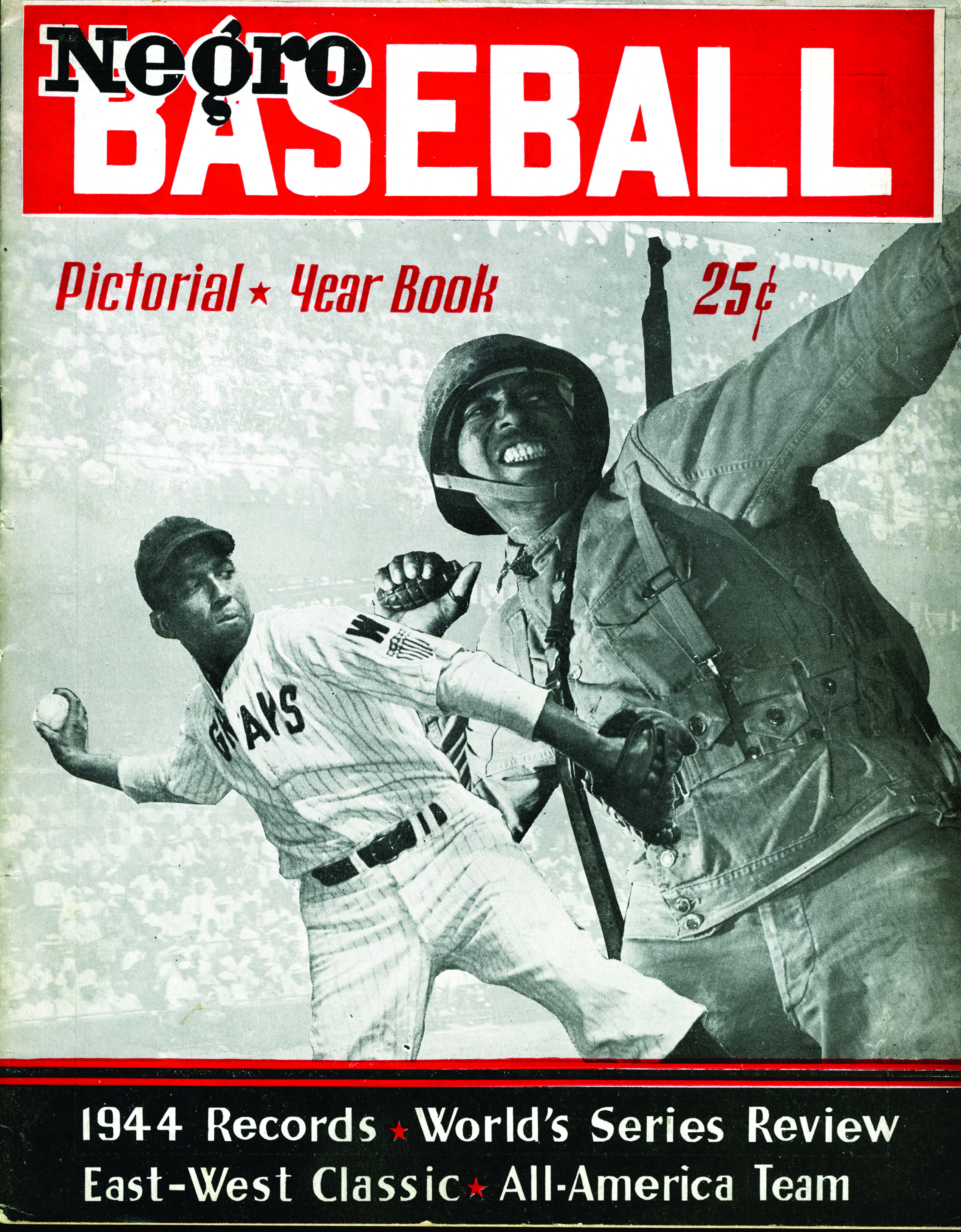
Negro Baseball Pictorial Yearbook, 1945
Collection of Civil Rights Archive/ CADVC-UMBC, Baltimore, MD
For more than 75 years, black players were banned from major league baseball. In response to this unwritten policy, the Negro leagues were formed in the late nineteenth century, a collection of professional baseball associations made up of predominantly African-American teams. The Negro leagues issued posters and handbills for distribution to black audiences, typified by this Negro Leagues yearbook from 1945. Its players were routinely covered in African-American periodicals, but remained invisible in the mainstream media.
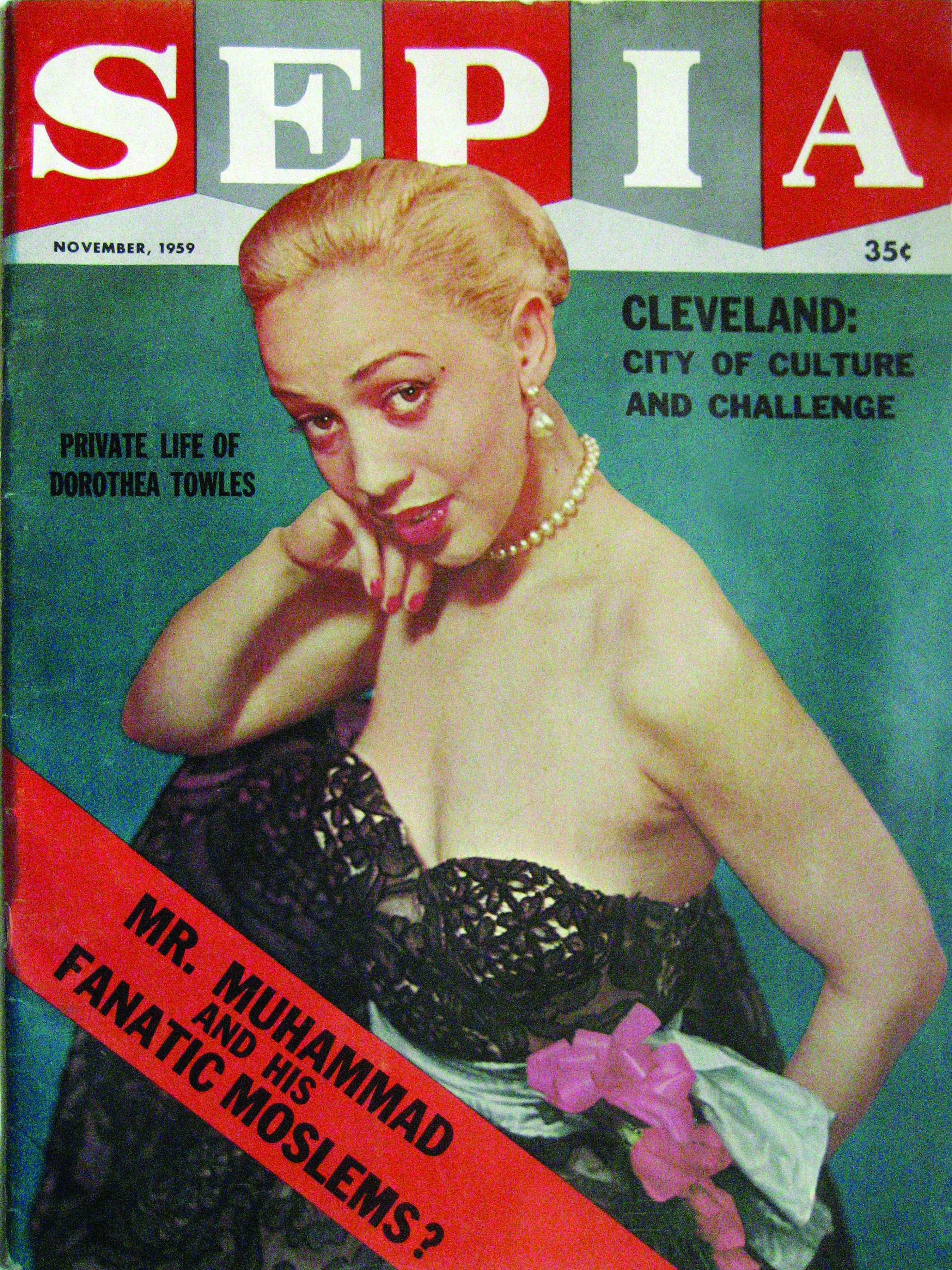
Sepia,November, 1959
Collection of Civil Rights Archive/ CADVC-UMBC, Baltimore, MD

The birth of the black pictorial magazine was an important event in civil rights history. Publications such as Ebony, Jet, and Tan (the first black women’s magazine), Our World, Say, and Sepia – the magazine illustrated here – played a major role in promoting affirmative black imagery in a popular culture awash with negative depictions. These publications emphasized photo-essays about African-American achievement and celebrity but also reported on the harsh reality of racism. The magazines’ upbeat content catered to subscribers and sponsors alike, providing readers with pictures that defied stereotypes and advertisers with stories that sold the idea of black success, stability, and affluence.
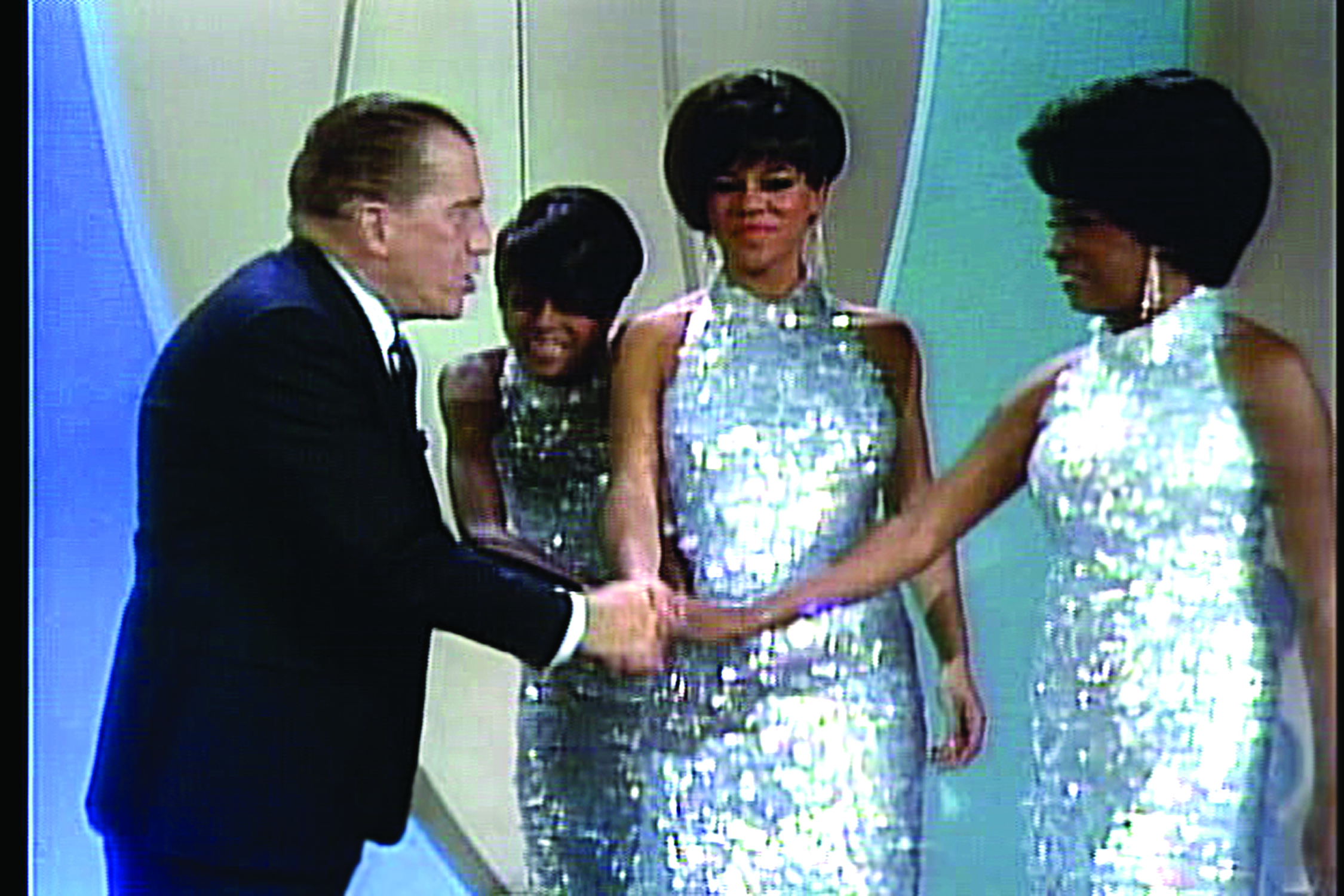
Screen Capture from The Ed Sullivan Show, c. 1966
(Ed Sullivan, The Supremes: Diana Ross, Florence Ballard, Mary Wilson) Courtesy The Ed Sullivan Show/SOFA Entertainment

While simultaneously entertaining Americans of all races, The Ed Sullivan Show (which ran from 1948 to 1971) did much to advance the cause of civil rights. If prime-time dramas and situation comedies of the civil rights era rarely featured African-American actors or subject matter, the program actively showcased black acts, making it a civil rights trailblazer. By depicting black and white performers interacting as equals, and by bringing these entertainers into the homes of millions of Americans, black and white, on a weekly basis, the program set an example of racial acceptance and integration, not just for the entertainment industry but for the nation at large.
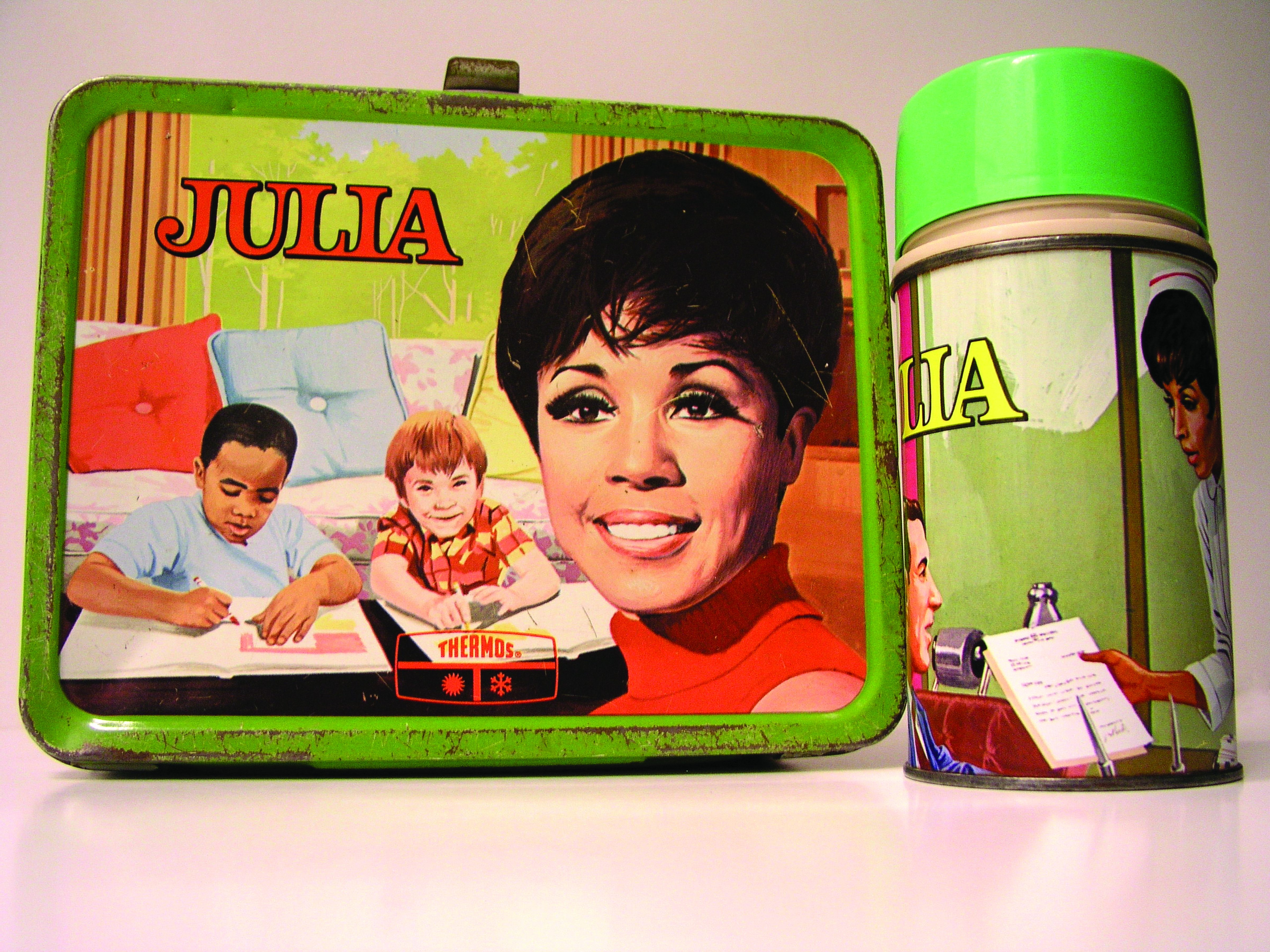
Lunchbox and Thermos: Julia, 1969
Collection Civil Rights Archive, CADVC

Julia (NBC, 1968-1971) was one of the earliest weekly, nationally broadcast built around a contemporary black character. The series centered on the everyday life of Julia Baker, a recently widowed nurse—played by Diahann Carroll—and her young son. Many critics viewed the show as groundbreaking, because of its refusal to promote racial stereotypes: Julia was intelligent, self-sufficient, well dressed, and beautiful, a far cry from the black servants and buffoons of 1950s television. If Julia broke ground, though, it did so in ways that would not intimidate white viewers: the main character rarely interacted with black friends or associates; she readily excused white people’s bad behavior; and she never demonstrated racial awareness or pride.
Childs Family, Washington, D.C., 1958
Collection of Faith Childs, New York
The most powerful and sustained vehicle for black self-representation and celebration did not require the cooperation of the media. Far from the stage sets of Hollywood and the advertising agencies of Madison Avenue, a simple, ever-present device was stoking a quiet visual revolution: the snapshot camera. As the popularity of increasingly inexpensive and easily accessible cameras swept across the nation in the early twentieth century, the images created by these cameras did for African Americans what a century and half of mainstream representation often could not: made visible the complexity of a people too often ignored by or erased from mainstream culture.

How to Win a Blind Taste Test (With Science!)

Josh WilhideWith Josh Wilhide ’10 M.S., Mass Spectrometry Facility Manager

On a hot summer day, there’s nothing quite like the perky fizz of a just-opened soda to keep you cool and caffeinated. As consumers, many of us are incredibly loyal to a particular brand – even to the point of being sommelier-level tasters of sodas.

Many people can tell the difference between Coke and Pepsi blindfolded. But how does the hardworking human taste bud stand up to the massive data-collecting power of one of UMBC’s mass spectrometers?

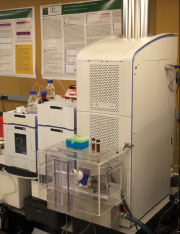
Josh Wilhide ’10 M.S., chemistry, can quench our thirst for this particular knowledge quite handily. Using one of the mass spectrometers in UMBC’s Molecular Characterization & Analysis Complex (or MCAC), and a bit of basic scientific reasoning, the mysteries of cola will be revealed!

TOOLS OF THE TRADE

  1. An oh-so-discerning palate
  2. Cups and paper for secret voting (no cheating!)
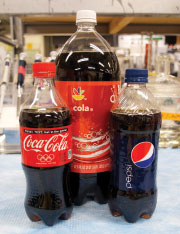
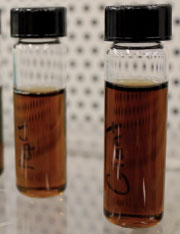
  3. Sample colas: Pepsi, Coke and generic (Giant brand)
  4. A mass spectrometer, if you can get one. Oh wait, we have seven of them right here at UMBC. 🙂

soda samples

STEP 1: Know Your Sample

Before you even warm up the spectrometer, it’s important to glean as much base information about your sample as possible. In the case of the colas in our experiment, we can immediately get a sense of flavor, of color, odor, and consistency. From a scientific perspective, it’s all relevant.

“The more information we have to start with, the better chance we are able to give you an answer,” says Wilhide, who handles mass spec requests involving everything from determining the atomic breakdown of soil, to reverse engineering pesticides found on produce.

“A lot of times people will bring in a sample of dirt, but you have to ask [questions about] where the dirt comes from, what you are looking for, what’s the concentration of what you’re looking for …the more we know about the sample, the more we’re able to pre-treat it to put it onto the instrument and get a better, more direct, answer.”

How To Step 2STEP 2: Find the Fingerprint

Want to know your cola at a molecular level? You’ve come to the right place.

When using the mass spectrometer, Wilhide first establishes a set of standards. Running tiny volumes –10 microliters to be exact – of each of the three known colas at the start allows the scientists to view a screen detailing the unique peaks and valleys of ingredients that make each product slightly different. Later, when he runs samples of unknown colas through the instrument again, Wilhide can compare the minute differences between knowns and unknowns – and ultimately identify which cola is which.

On the computer screen, with control specimens and unknowns side by side, Wilhide can make sense of the zigzagging green lines that represent masses specific to each soft drink.

“Each cola has a unique fingerprint,” says Wilhide. “Once we put the screen in, we get a pretty instantaneous response from the mass spec. Once you see them together, you can start putting the pieces back together.”

How To Step 3STEP 3: Teach With Your Tools

At this point, you’re probably thinking: that’s great, but I don’t have a mass spectrometer of my own to measure my own colas. But, assuming is bad, folks, especially in science.

“Actually, one of the great things about our center is that we do offer training for students and other people [including alumni] who want to learn how to use these instruments on their own,” said Wilhide. “A lot of places won’t let their undergrads near equipment like this, but we’re trying to be a model. It’s a new way of teaching.”

Making this technology accessible to students not only means they can run their own tests and learn along the way – they can also help out with the jobs the MCAC gets from outside clients who are looking for a little scientific detective work of their own. Each day presents a new challenge, a new “fingerprint” in need of uncovering.

“I like taking a mystery and making sense of it,” says Wilhide. “Not to be cliché, but I like the puzzle.”

VIDEO: The Taste Test

Watch as Wilhide and junior biology student Suejane Tan test the colas the old fashioned way (yummy!) and using the MCAC’s shiny new AxION TOF with DSA source both made by PerkinElmer (sciency!). Who will be victorious? Watch the video here.

Interested in learning more about the Molecular Characterization & Analysis Complex (MCAC) at UMBC? Visit it online here.

— Jenny O’Grady

Discovery – Fall 2012

EXPLORING THE BORDER

When human beings have to be at a certain place at a certain time, they have lots of handy aids to do so: alarm clocks and watches, maps and GPS systems.

Michelle Starz-Gaiano, an assistant professor of biology at UMBC, is fascinated by the question of how cells do the same thing.

“Cells leave on time and get to a destination on time during development,” she says. “They get to the right places almost all the time and they don’t get lost.”

What guides cells? One aspect of this question that researchers in Starz-Gaiano’s lab want to understand is how cells decide which particular ones in an organism will move and which will stay.

For instance, many cells must divide as a person develops from an egg to an embryo, to a human being. And as they divide, those cells must also reorganize themselves – and many of those cells migrate to different locations within an organism to fulfill their missions.

Starz-Gaiano and her colleagues are studying cell migration in fruit flies, concentrating specifically on a population of cells called “border cells.”

“Genes and proteins are similar between humans and flies,” Starz-Gaiano observes. “So if we can understand how they work in a simple system like flies, it really predicts how they’re going to act in humans.”

The relative simplicity of fruit flies also helps aid researchers. “In flies you can see how molecular changes translate to the whole organism,” she says.

How do Starz-Gaiano and her colleagues unlock the secrets of cell migration in flies? Biologists call it “loss of function” – but what it comes down to is simple subtraction and observation.

“We take away one gene at a time and see if the cells migrate or not,” she relates. “Then we can infer that those genes are required for cell migration.”

Studying cell migration is not just about exploring genetics. The observation of the border cells requires a great deal of live imaging with a microscope – which offers an enhanced look inside the process that is not available with a simpler two-dimensional observation.

“One surprise that came out of the live imaging is that [the migrating border cells] rotate,” says Starz-Gaiano. “People have done a tremendous amount of work looking at cell migration in tissue culture dishes where the cells are moving across two dimensions.” Live imaging offers the “huge advantage to look at the whole tissue at once.”

Interdisciplinary collaborations with the mathematics and chemistry departments, funded with help from the National Science Foundation (NSF) and the National Institutes of Health (NIH), have been a key to advancing the work being done in Starz-Gaiano’s research lab. (She is also the recipient of an NSF Early Career Award.)

The NSF’s Undergraduate Biology Mathematics Program has allowed Starz-Gaiano to team up with assistant professor of mathematics Bradford Peercy. “We’re doing some mathematical modeling to answer some of the harder questions about how the cells are moving and which cells are specified to move,” she observes.

Another grant from the NIH’s Chemistry Biology Interface Program (aimed to encourage interdisciplinary work by graduate students) is facilitating collaboration between Starz-Gaiano and UMBC professor of chemistry Katherine Seley-Radtke to explore applications that the cell migration research might have on drug design. Because cell movement is controlled in part by a cascade of molecules, this partnership is allowing researchers to work toward assembling drugs, molecule by molecule, that may inhibit some of the biological processes that promote cell migration.

— Nicole Ruediger

WIRELESS IS MORE

Baltimore Heritage

Most professors urge students to write concisely. But the students in Denise Meringolo’s public history class recently faced an extreme challenge to be succinct: Turn in a final project just 150 words long.

The work submitted by Meringolo’s students helped create a new smartphone app for Baltimore Heritage, a nonprofit preservation organization. The app leads users on a walking tour of Baltimore – and the 150 words is about as much text as can be read easily on an iPhone screen.

As an assistant professor of history and the coordinator of the public history track in the historical studies M.A. program, Meringolo often uses her Introduction to Public History class to collaborate with external partners on ways to enhance public understanding of history. Yet some of these classroom collaborations were never implemented by partner organizations, an outcome that was frustrating to a professor who likes to call her class: “Committing History in Public.”

Meringolo’s luck changed when she met Eli Pousson through UMBC’s Orser Center for Place, Community and Culture – where they are both board members. Pousson is the field officer for Baltimore Heritage, which needed content for their new “Explore Baltimore Heritage” app.

“It seemed like a very natural partnership,” says Pousson.

The collaboration on the app allowed UMBC students like Shae Adams ’13, M.A., historical studies, to wrestle with the issues faced each day by public historians. “I’ve had years of practice writing traditional research papers,” says Adams. “But to tease out a single story from that research and tell it in about 150 words? Much more challenging. Throughout the semester, I found myself loving the inherent challenge of interpretative public history.”

Meringolo’s partnership with Baltimore Heritage will continue this fall, when the graduate students in a class she’s called “West Side Stories” will create digital narratives – including oral histories – for the organization’s app.

Ironically, Meringolo doesn’t even own a smartphone yet. But she teaches her students that the principles of good storytelling stay the same no matter how the tale is conveyed.

“The mode of delivery is changing, not the impulse behind it,” says Meringolo, who has just published a new study of her discipline’s trends from the nineteenth century until today titled Museums, Monuments and National Parks: Toward a New Genealogy of Public History (University of Massachusetts Press).

It’s no surprise that Meringolo sees her own work as part of that continuum, and she values the fact that UMBC is also becoming ever more engaged in the work of public history. “Public history is an intellectual discipline in the service of the community, and public universities are supposed to be in service to the world around them,” she says. “The more we can recognize that humanities scholarship is also a problem-solving toolbox, the more we can be relevant to the world around us.”

Meringolo has her sights set on 2016, when the National Council on Public History will hold its annual conference in Baltimore. UMBC’s partnership with Baltimore Heritage is one concrete example of what’s in the problem-solving toolbox of the humanities at the university. But the professor who likes “committing history in public” also hopes that it’s another step toward making UMBC a model of community collaboration by the time public historians arrive in Baltimore.

— Chelsea Haddaway

Conserve and Protect – Lekelia “Kiki” Jenkins ’97, BioSci

As a child, Lekelia “Kiki” Jenkins ’97, biological sciences, could often be found on a fishing pier on the Chesapeake Bay, dangling a line for fish or chicken-necking for blue crabs with her family.

Today, you’re more apt to find her on a commercial fishing boat in Ecuador as she researches how fishermen can keep from catching protected species such as sea turtles.

It’s a race against time as Jenkins works with fishermen and government regulators to adopt new technologies out on the water. It can take 15 years or longer to come up with a new device to keep sea turtles from being snared by hooks or to prevent dolphins from getting tangled in nets.

“When you’re looking at some of the forecasts of when animals are going to go extinct – like leatherback turtles, which could be a decade before they’re extinct in the Pacific Ocean – then 15 years is too long of a time frame,” said Jenkins, who is now an assistant professor at the University of Washington in Seattle.

Jenkins focuses not only on the mechanics of the devices she’s helping to streamline – called bycatch reduction devices – but also the factors that lead commercial fishermen to adopt them or reject them. In particular, she’s been evaluating barriers that might prevent fishermen in other countries from using the devices that American regulators are pushing.

She blends a touch of the social sciences into biology, understanding not just how the animals behave with the devices, but how the people who use them behave, too.

“It’s really about the people, and the people are having an impact on the environment,” Jenkins said. “What’s going to effect change really starts with humans and why they do what they do, and where there are opportunities to improve that.”

Jenkins also studies how commercial fishermen might switch their fishing gear to different types that are less lethal to protected species – from nets, say, to baited fishing lines. She is also working on recounting historic fishing harvests to better understand how humans have influenced marine life.

Jenkins’ research often takes her out on the water, working alongside commercial fishermen.

“Fishermen are wonderful. They like me, so I’m lucky,” Jenkins says with a laugh. “They are really sweet, very open. They take their time to share.”

Jenkins’ career path was shaped by her mentors at UMBC. A former junior zookeeper at what is now the Maryland Zoo in Baltimore, Jenkins initially considered studying veterinary medicine and endocrinology, so she could work in captive breeding.

But it was in the late UMBC professor of biological sciences Carl Weber’s ecology class that she found her calling.

“I was reading through the textbook, a chapter we weren’t assigned on conservation ecology, and I thought, ‘This is it! This is what I want to do,’” Jenkins recalls.

In addition to Weber, Jenkins credits other UMBC faculty, including associate professor of geography and environmental systems Sandy Parker, senior lecturer in chemistry Mark Perks, and former associate vice provost Teresa Viancour (who let Jenkins into the lab at night to observe electric fish) with helping her understand where her biology training at UMBC could take her.

Jenkins also found a “wonderful oasis” in UMBC’s dance department, where she earned a minor and found a creative outlet in an interest she continues today. In fact, after Jenkins earned her Ph.D. in marine conservation at Duke University in 2006, she choreographed a dance about her dissertation on sea turtles. It won second place in a dance competition sponsored by the American Association for the Advancement of Science.

Jenkins says the arts and science can mesh better than many might think. In fact, art can be used to communicate science to non-scientists.

“What I tell people all the time is that, especially when it comes to the environment, people’s interest in environmental issues are triggered by all sorts of things,” she said. That could be experiences in nature, photography, poetry or literature. It makes sense, she said, to communicate science through those same channels.

“If we as scientists want to deliver information back to stakeholders and people who care about the environment, doing scientific papers is insufficient,” she said.

Jenkins practices what she preaches, writing general-interest articles alongside each of her academic papers. In 2011, for example, she blogged about a research trip to Ecuador for the New York Times.

Jenkins hopes her work – whether with regulators, fishermen or regular folks – can help save vulnerable species.

“I want to make a difference. I want to have a lasting conservation impact,” Jenkins said. “When I did my dissertation, I said to my advisor: ‘I want to do work that someone’s going to use. It’s not going to sit on a shelf.’”

— Pamela Wood

At Play – Fall 2012

PUZZLE POWER

Marie desJardins, a professor of computer science at UMBC, specializes in research on artificial intelligence. But at the 2012 American Crossword Puzzle Tournament in March, her research became downright competitive when desJardins crossed pencils with a crossword-solving computer program.

The progam, dubbed “Dr. Fill,” was going up against one of the best crossword puzzle solvers in the country. DesJardins is the top-ranked female solver in the Mid-Atlantic region and she is the 44th best solver in the country. (Dr. Fill finished the same tournament in 141st place.)

“I didn’t realize I could be this good at crossword puzzles,” says desJardins. She adds that her development as a crossword competitor also highlights the hurdles to bringing more women into the sciences.

“A lot of girls think that they must not be intrinsically good at ‘that stuff,’” argues desJardins, who adds that the biggest impediments are “the psychological blocks we put up for ourselves.”

DesJardins has been closely involved in programs at UMBC to remove those blocks, including the Center for Women and Information Technology (CWIT). She also works with the Multi-Agent Planning and Learning Lab (MAPLE), which she founded in 2003 to facilitate student research in artificial intelligence.

DesJardins has her eye on next year’s tournament – if she can reconcile it with an academic conference scheduled for the same weekend. “I might go to that conference,” she says. “But I’ll have to leave early to go to the tournament.”

— Andrew Holter ’12

NOT CAMERA SHY

Orientation Peer Advisors

Even on a campus as welcoming as UMBC, some incoming freshmen and transfer students find that orientation makes them nervous. There’s the stress of course selection and presentations on campus life, but also the question that comes with joining any new community: Will I make new friends?

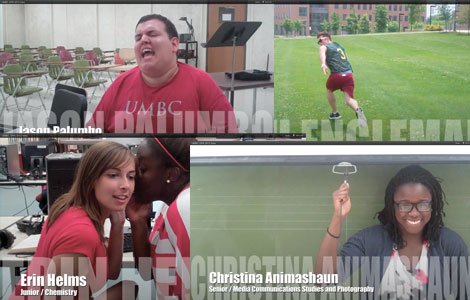
This year’s contingent of UMBC Orientation Peer Advisors (OPA) decided to break the ice with a bit of video comedy, powered with the Mika song “Love Today” as a soundtrack. This year’s advisors are caught in a range of fun and goofy activities: playing video games, dancing, tossing a football, chasing ducks, bumping into things, and that perennial undergraduate favorite: sleeping.

Christina Animashaun ’13, who studies media communications and photography, teamed up with Jason Palumbo ’13, a graphic design major, to make the video in a single day. Palumbo was behind the camera, and Animashaun coordinated the sequences. Spontaneity was a key to the feel of the video: “It was very much talking out the storyboards,” says Animashaun, “as opposed to having it all set and ready to go.”

An introductory video made by the Orientation Peer Advisors has become a staple through the years, but the 2012 video duo wanted to get this year’s orientation started with a jolt of humor and movement.

“On the morning [of orientation], people are rolling up at 8 or 8:30 a.m,” says Animashaun. “They’re hyped up on coffee, and then you [show the video]. It’s like, ‘Hey, we’re real people. We’re real students…” Palumbo finishes the thought: “…and we also like to dance.”

Watch the video here.

— Nathan Glover ’12

SPURS OF THE MOMENT

Tottenham Hotspur Football

North London’s Tottenham Hotspur Football Club (often called “Spurs” for short) is one of the world’s great soccer teams, having recently played in the UEFA Champions League and finishing fourth in the English Premier League last season. Clad in iconic white and dark blue uniforms adorned with a cockerel, Spurs are known for playing an attractive, free-flowing and attacking football.

For one sweltering day in late July, however, Spurs found a home on UMBC’s campus, which they used as a training facility before a July 28 friendly match at Baltimore’s M&T Stadium against Liverpool Football Club –another one of England’s biggest and most iconic teams.

Tottenham stars including Gareth Bale, Aaron Lennon, and longtime U.S. men’s national team goalkeeper Brad Friedel got in a morning training session on UMBC’s soccer field under the watchful eye of new Spurs coach Andres Villas Boas. Spurs players then adjourned for lunch at the True Grits dining hall.

Later that day, young Maryland soccer players sampled how Tottenham coaches players in its own football academy at an afternoon clinic led by Spurs’ head of football development Mark Jones.

“We plan for everyone to get 2,000 or so touches of the ball this afternoon,” Jones told the players and their parents before putting them through an afternoon of coaching and drills.

It is the second time in four years that world soccer powers have used UMBC’s state-of-the-art facilities on visits to the region. In 2009, English and Italian soccer powers Chelsea and AC Milan trained at UMBC before a friendly match.

— Richard Byrne ’86

THE RINGS THING

Mohamed Hussein '13

Every four years, the Olympic Games give athletes a chance to chase their dreams and compete at the highest level.

For UMBC swimmers Mohamed Hussein ’13 (Egypt), Patrick Husson ’14 (USA) and Pierre De Waal ’13 (South Africa), those dreams almost became reality. Husson and De Waal competed in the Olympic Trials of their respective home countries but fell short of earning a trip to London.

Hussein did his teammates one better – qualifying for Egypt’s team in the 100-meter freestyle and the 200-meter individual medley. But his trip to London was cut short by FINA, the international governing body of swimming, which abruptly changed the qualifying times required to make the Olympics. Hussein’s times fell just short.

“[In] all the past Olympic games, FINA allowed more than 1,200 swimmers to participate in the competition,” Hussein observes.

Despite the disappointment, Hussein remains one of the best swimmers in his native Egypt as well as at UMBC, and calls 2012 “the best year in my swimming career.”

De Waal had to return to South Africa to compete in the Olympic Trials during the spring semester. After a day and a half of travel from Baltimore to Durban, De Waal took to the pool for his best event, the 200-meter butterfly, where he fell to fellow countryman Chad le Clos, who went on to win gold in the Olympics over U.S. Olympic swimming star Michael Phelps.

Former walk-on Patrick Husson also swam in the Olympic Trials in his best event, the 200-meter breaststroke, finishing 99th out of 132 competitors.

“The three of them have all raised the level of our competition and our team,” UMBC swim coach Chad Cradock ’97 says.

— Dan Levin ’13

Alumni Essay – Battles Can Build Bridges

Proposition: The natural sciences will forever be at odds with the humanities and social sciences. Steven Gimbel ’90, philosophy and physics, argues in the negative. As chair of the philosophy department at Gettysburg College and the author of works such as Einstein’s Jewish Science: Physics at the Intersection of Politics and Religion, Gimbel has made his career finding useful and provocative intersections between the sciences and the humanities and social sciences.

* * * * *

There are days in college that leave an indelible trace on your mind. I will never forget sitting in professor (and now professor emeritus of physics) Robert L. Rasera’s solid state physics class about two weeks from the end of the semester, when Jon Lau ’90, physics (who busted every curve), asked for clarification about the topic being discussed.

I recall that Rasera paused, and then said three little words: “We don’t know.” Not “I don’t know,” but “We don’t know.” And as he sketched out competing views, everything changed for me.

As a double major in physics and philosophy, I was used to discussing disagreements between philosophers – that’s just what philosophers do. But science had always been beautifully clean. Every problem had an elegant solution. All equations had seamless derivations. Problems were solved exactly.

That moment in Rasera’s class showed me that science was also a process involving people arguing with each other. It was the real physics, the messy physics, the human physics. I had found the philosophy in the science – and I have stayed there ever since.

As a philosopher of science, students often tell me: “This philosophy stuff is interesting, but I believe in science.” Their mistaken view is something one could easily infer from the way we do things. We create departments of physics, chemistry, and biology, and then locate them in buildings away from history, sociology, and political science. Much of what we do at universities can entrench the idea that these divisions are absolute. Natural sciences go in one box, pack the humanities in a different one, and leave the arts and social sciences to their own.

But it just isn’t so. There’s no competition here, and no need to choose sides. Indeed, these seemingly disparate disciplines are complementary, working together to create multifaceted minds that appreciate the full breadth of the world and derive insight and wisdom from it.

Sociologists like Robert K. Merton, historians like I.B. Cohen, and philosophers like Thomas Kuhn looked at scientific communities and the reasoning of individual scientists in order to embed discoveries in historical and cultural contexts. If we want to understand not only how the science works, but where it came from and why it appeared when it did, then we need to blend our disciplines across borders.

This is what I do in my latest book Einstein’s Jewish Science. The title comes from a phrase used by the Nazis to denigrate the theory of relativity. Like so much that came from Hitler and his minions, we now dismiss it as absurd propaganda. But look closely at the history of our sciences, and you’ll realize how inextricably intertwined they are with the politics, ideas, and religious beliefs of their day.

But interdisciplinarity isn’t merely a retrospective exercise. It is essential to developing the minds of scientists who will move us forward. During the last week of my first semester of quantum mechanics at UMBC, I remember professor of physics Ivan Kramer discussing the interpretation of the equations we had been studying. The theory itself, Kramer argued, was “a bunch of squiggles.” But then he asked what those squiggles meant.

Again, I found philosophy in my physics class. Because looking for meaning, after all, is what a philosopher does. Some of the squiggles represented mass or length – things that can be measured. Others were mathematical symbols, like an equal sign, that form the grammar of mathematical language. And there were more squiggles standing for potential field values, curvature tensors, and other weird things that we can’t see. If the theory is true, how do we make sense of these? What does the theory mean? What does the universe really look like if this theory describes how it works? The equation doesn’t answer these questions. Philosophy does.

This meditation leads us to two important elements of interdisciplinarity. First, what theory tells us about the world may compel us to completely change how we understand ourselves and our universe. Moving from a geocentric to a heliocentric view of the solar system did not change an inconsequential technical parameter. The earth was removed from the center of Creation. There were other planets just like ours, and other suns just like ours. This required a full reworking of our relation to the universe.

Scientific advancement and new technologies lead to yet another place where the sciences and humanities collide and collaborate. New discoveries force increasingly complex ethical issues onto the cultural stage. Technology gives us new tools and science gives us the know-how to use them in unforeseen ways. But the questions of meaning are urgent: Should we use them in those ways, or indeed at all?

Again, consider Einstein, who saw the horrors of the two world wars in which science and technology helped create mass death. Knowing that the great German physicist Werner Heisenberg had been enlisted by the Nazis to create an atomic weapon, Einstein and fellow physicist Leo Szillard wrote to warn President Franklin Delano Roosevelt. That letter helped create the Manhattan Project, which also led to the nuclear arsenals that shaped the Cold War and now stoke our greatest fears concerning terrorist organizations. Einstein later said: “I could burn my fingers that I wrote that letter.” Science yields knowledge, but that knowledge also forces weighty and complex moral decisions upon us.

We are faced with new and daunting ethical challenges each day because of the progress of science and the technology derived from it. That will not – and should not – change. But it does require us to shed the old way of thinking of knowledge in boxes. We must cross boundaries, weaving together the natural sciences, the social sciences and the humanities. This is what education for a new age needs. It is what I received – and what students still receive – at UMBC.